
Hotels Locations

more locations
hide locations
inisrael.com travel guide

Search for

Enjoy Israel

HE
The Western Wall Time Line Jerusalem
inisrael.com travel guide

Israel Hotels

Enjoy Israel

The Western Wall Time Line Jerusalem

The Western Wall Time Line Jerusalem

Jerusalem travel guide

1000 BC – Purchasing Mount Moria

King David conquered Jerusalem, which was a Jebusite city located on the Ophel hill, southeast of today’s Old City area. He bought a neighboring hill, which was later identified with Mount Moria (the site of Isaac’s sacrifice), on which he placed the Ark of the Covenant.
950 BC – The Construction of the First Temple
King Solomon, the son of David, built the First Temple on Mount Moria, which known today as the Temple Mount.

586 BC – The Destruction of the First Temple
Nebuchadnezzar, King of Babylon, conquered Jerusalem, burnt the Temple and exiled the Jews to Babylon.
515 BC – The Construction of the Second Temple

In 537 BC, after 50 years in the Babylonian exile, the Jews were allowed to return to Jerusalem and began to rebuild the city and the Temple. The Second Temple was completed in 515 BC.
Model of Second Temple

37- 4 BC – Herod’s Temple Herod the Great was appointed to the King of Judah and begun to reconstruct the Second Temple and to build the Temple Mount. He built an incredibly magnificent temple and a retaining wall around the Temple Mount enclosure.
70 AD – The Destruction of the Second Temple

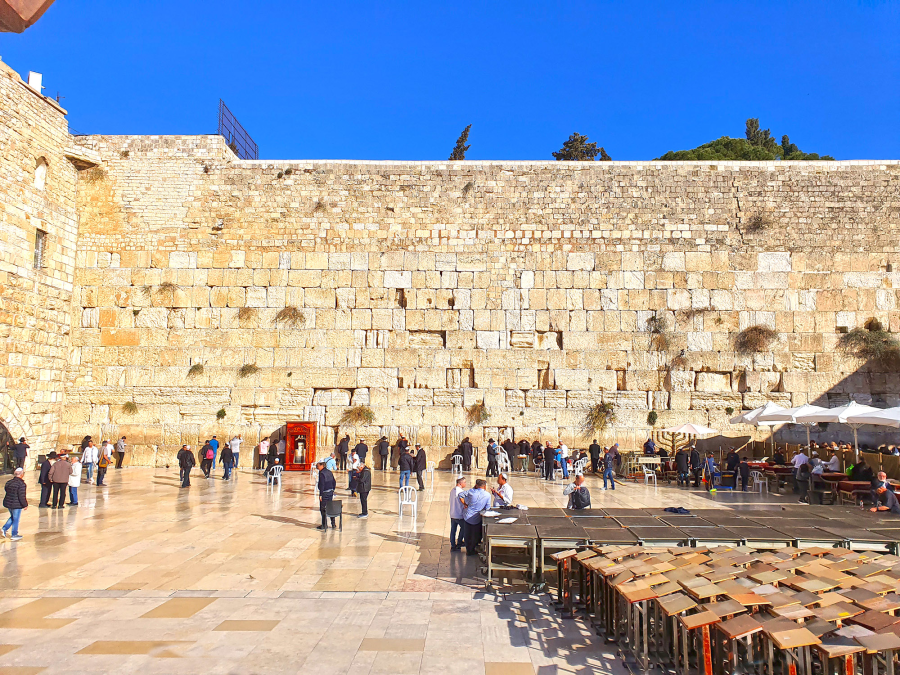
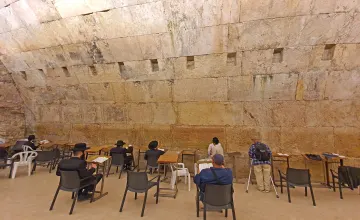
The Great Revolt of the Jews against the Romans led to the fall of Jerusalem and the destruction of the Temple by Titus. The only remnant left was the western part of the Temple Mount’s retaining wall, which became the focal point of the Jewish people throughout the centuries. The authentic bricks of that wall can be seen at the bottom rows of today’s Western Wall.
May 14, 1948 – The Western Wall Falls to Jordanian Hands

A few hours after the official proclamation of the state of Israel, the Arab armies of the neighboring countries invaded Israel, and the terrible War of Independence begun. The Old City of Jerusalem, with the Western Wall in its center, fell to Jordanian legionnaires.
Western Wall – Virtual Tour

June 7, 1967 – Israel Regains Control of the Western Wall
During the Six Days War and after 19 years, in which the access to the Wall was prevented from the Jews, the Israeli army recaptured the Old City of Jerusalem, and liberated the Western Wall.
The Year 2000 – E-Communication with the Western Wall

Maintaining the old tradition of placing a note with a prayer to God in the Wall’s bricks, the era of High Technology and e-communication provides a virtual answer for those who like to send their prayers to God, without actually visiting the Wall. The believer can now send his request via e-mail or fax and it will be placed between the Wall’s bricks.

Hurva Synagogue in Jerusalem's Old City

Hurva Synagogue in Jerusalem's Old City

The Hurva Synagogue is located in the Jewish Quarter in Jerusalem's Old City. The synagogue was built in the 18th century, and has gone through many upheavals: It was destroyed by Muslims, rebuilt in the 19th century, destroyed again, and in 1948 - after the Old City was occupied - it was renovated yet again, and it was reopened in March 2010. A sound and light show is screened on the structure's eastern wall, surveying the synagogue's 800-year history (the show is presented free of charge in the evening hours). The Hurva Synagogue is named after Rabbi Yehuda he-Hasid, who headed Poland's Jewish community in the 18th century. Rabbi Yehuda he-Hasid immigrated to the land of Israel, with his students, some 300 years ago, to advance the Messianic Era. The rabbi and his students bought an abandoned plot on which to build a synagogue, financed by loans which they used to pay the landowners. Rabbi Yehuda he-Hasid died just days after an acquisition agreement was reached; his students remained a flock without a shepherd, but were able to raise funds from the Diaspora and take out loans from local Arab residents in order to continue the plan to construct a splendid synagogue. After some twenty years, Muslims set the synagogue and the Torah scrolls in it ablaze, claiming that they were not paid what they had been owed, and that the place had become The Ruin of Yehuda he-Hasid. Because of the debt, the Ashkenazi Jews were expelled from Jerusalem and those who wanted to enter the city had to disguise themselves as Sephardic Jews - in dress and style - so as not to be identified. After 140 years, during Turkish rule, the decree against Ashkenazi Jews was reversed and construction of the synagogue was renewed, funded by Moses Montefiore and Baron Alphonse, a brother of Baron Edmond Benjamin James de Rothschild. The structure of the splendid synagogue was planned in the neo-Byzantine style, which characterized many houses of worship throughout the Ottoman Empire and included four square towers with four 16-meters arches between them. Over the arches rose a large, spectacular dome. The synagogue became a spiritual center in Jerusalem's Old City, until the 1948 War of Independence. During the war, the synagogue was bombed, the structure collapsed and was destroyed, and only two pillars remained standing. After the 1967 Six Day War, as part of renovation activities in the Jewish Quarter, wide-spread construction work commenced, alongside archaeological digs in which artifacts from different eras were discovered, including: Mikvehs (ritual baths) from the time of the Second Temple and a street from the Byzantine Period, which are displayed in the synagogue basement. The synagogue was inaugurated and reopened on March 15, 2010.

The Armenian Quarter - Jerusalem Old City

The Armenian Quarter - Jerusalem Old City

Situated to the right of the vibrant Christian Quarter is the secret Armenian Quarter, the most isolate of all of the quarters in the old city. The quarter goes back to the time when Armenian Christianity began and has a long history of Armenian pilgrims setting foot at its gate. The discovery of holy sites for Christians in the city caused many of the pilgrims to become fixed residents in the Armenian Quarter. Dating back to the turn of the fourth century, when Armenia was declared as the first Christian state in the world, the Armenian Quarter developed into one of the main substances in the Christian entity of Jerusalem. Due to wars and peregrination the Armenian populace in the old city has shrunk these days to a little under 1000. Still, this tight community lives its life in the surroundings of St. James Church, which envelopes the Armenian faith in Jerusalem and is also the residual place of the Armenian patriarchate. Unfortunately, the Armenian Quarter is far from living up to its full tourism potential. With the church and its surrounding areas closed to the public, in the quarter you can visit teh museum of the Armenian history and artwork, which is quite interesting but not easily found.

The Holy sites of Jerusalem

The Holy sites of Jerusalem

Being the most important city for all major religions, the old city of Jerusalem is probably the most fascinating trip you can make while visiting Israel. The history of Jerusalem combines some of the most important events in Jewish and Christian history alike, and the religious sites spread throughout the city capture the imagination of each and every visitor. The Wailing Wall (the Western Wall) is the first stop for Jewish travelers in the old city of Jerusalem. It is the only remaining part of the ancient temple of King Solomon which has become the holiest spot in Jewish life and an Israeli national symbol as well. The Wailing Wall is where Jewish worshipers pray in a designated area in front of the holy site; mourn over the destruction of the Temple by the Romans, and wish for the return of Israel's former glory. They also write their personal requests from G-d and post it in little notes between the wall's ancient stones. Mount Zion is another Jewish and Christian holy site you wouldn't want to miss. According to Jewish tradition, Mount Zion is the burial place of King David. Today, it is one of the most popular Jewish burial sites in Jerusalem. Mount Zion is very significant for Christians as well: according to Christian belief, it is where the last supper was held, in the building identified as the Coenaculum, which is also where Jesus reappeared after his resurrection. According to Christianity, in this area of the city the disciples and early Christians were living at the time. Beyond its history, Mount Zion offers some spectacular views of the old city of Jerusalem. Jerusalem's vicinity offers several other significant sites for Christian visitors: the nearby Bethlehem, where Jesus was born; the Mount of Olives, where he ascended to heaven, according to Christianity; and the Church of the Holy Sepulcher, which is the first among the Christian shrines in the Old City of Jerusalem, where the resurrection has been celebrated for many centuries as the most sacred place in all of Christendom. Plus there is the Via Dolorosa, the holiest Christian thoroughfare in the world: This path is symbolically reliving the events of the passion, and includes the shrine of the ascension, the Garden of Gethsemane and Mount Zion. The holy sites of the old city of Jerusalem have defined its nature for thousands of years and still reflect its remarkable history and significance. Visiting some of these sites and wondering through the streets and markets of the old city is an experience you will carry with you for many years after visiting one of the most special cities in the entire world.

Jerusalem - one of a kind
Please wait...
  • Please wait while the system searches for you the perfect vacation at the best prices.

Search for

Why Inisrael.com?

  • Book direct - We connect you to the hotels.
  • The best hotel deals in Israel.
  • You pay at the hotel - upon arrival.
  • Credit card for room guarantee, no upfront payment.
  • The first israel booking site since 1996.