
Hotels Locations

more locations
hide locations
inisrael.com travel guide

Search for

Enjoy Israel

HE
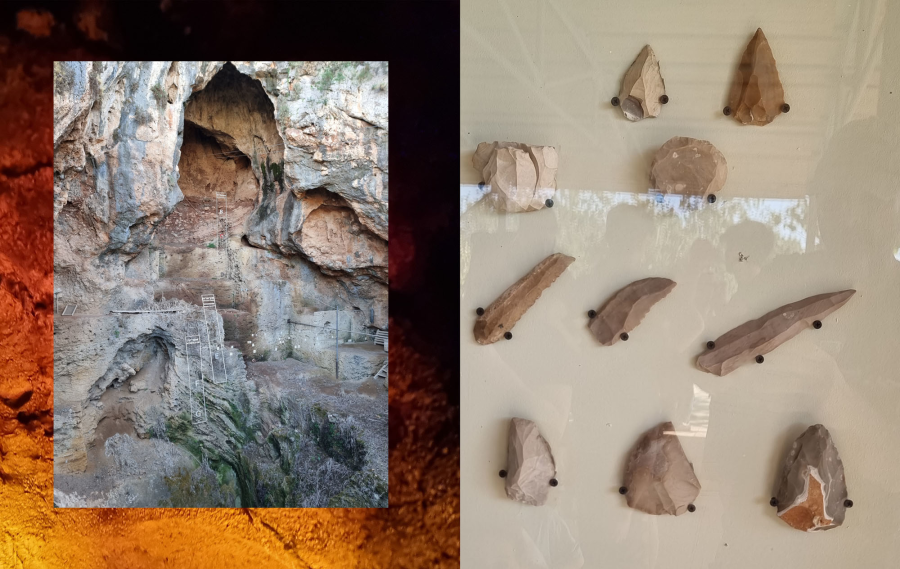
The Tabun Cave is a prehistoric site – A Neanderthal cave!
inisrael.com travel guide

Israel Hotels

Enjoy Israel

The Tabun Cave is a prehistoric site – A Neanderthal cave!

The Tabun Cave is a prehistoric site – A Neanderthal cave!

Tour travel guide

The Tabun Cave is a prehistoric site located in Israel, near Zichron Yaacov and Fureidis not far from Haifa District of Israel. . The cave is known for the discovery of Neanderthal remains, which were found there in the 1930s by archaeologist Dorothy Garrod. These remains, along with other artifacts and tools found in the cave, have provided important insights into the lives and culture of Neanderthals and have helped to shed light on the early history of human evolution.

The Tabun Cave is one of a number of prehistoric sites in the region, and it is believed to have been used by Neanderthals for a variety of purposes, including as a place to live and as a site for carrying out activities such as hunting and foraging for food. The cave contains several layers of sediment, which have allowed researchers to study the changes in Neanderthal culture and behavior over time. The Tabun Cave is a significant site for the study of human evolution and has contributed greatly to our understanding of the history of our species.

The route of the ancient man caves, including audio-visual vision

A circular geological route
The Ancient Man’s Trail – a tour route that climbs the stairs and goes up to the entrance of the Tabun cave named after the opening in its ceiling. The first excavations in this cave were conducted in 1927, led by researcher Dorothy Garrod. Today a delegation from the University of Haifa is excavating the cave, and the excavation is done in layers that are about 20 meters deep. The route continues to the camel cave, so called because its shape resembles a hump.

It is possible that an activity of raw material processing was carried out in the Camel Cave. In this cave there are exhibits that illustrate the nature of life in the various prehistoric periods. In the next cave on the route, the river cave (al-Wad), there is a spacious entrance hall, and at the end a narrow corridor that is about 70 meters long. In front of the front of the cave stretches a wide rock step. Most of the findings in the cave belong to the culture known as Aurignacian (40,000 to 20,000 years before our time). The cave was abandoned for several thousand years, and when man returned to the place, the center of gravity of life moved to the entrance hall and the rock step in front of the cave (the Natopian culture, 12,000-10,000 years before our time). In this cave, an audio-visual presentation illustrating the way of life of ancient man is shown, and at the entrance there is a reconstruction of a burial site.

The botanical trail – a circular route marked with blue trail markings. The path leads east along the length of Nahal Ma’rat and climbs through dense Mediterranean vegetation on the southern side of the stream to the top of the ridge, where it passes through a natural forest of Jerusalem pine. From there it continues west to an impressive view of the Carmel beach and the sea and descends back to the starting point.

The geological trail – a circular route that climbs to the top of the northern cliff of the reserve. The path is controlled by wooden posts engraved with arrows and station numbers. From the highest point on the route there is a spectacular view towards the Carmel beach plain.

The path to Merat HaGadi – a short path leads to the easternmost prehistoric cave in Nahal Merat. Skeletons of modern man (Homo sapiens), belonging to the Mousterian culture (around 90,000 years ago) were found in the cave. This finding indicates that it is possible that a population of modern man lived in Nahal Merot next to the population of Neanderthal man, which existed in the Tabon Cave.
The Baha'i gardens in Haifa

The Baha'i gardens in Haifa

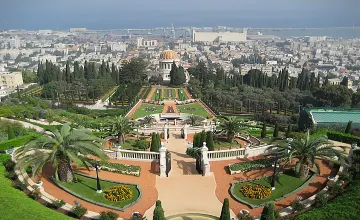
The Baha'i gardens in Haifa are made up of nineteen tiered gardens (terraces) starting at the top of Mount Carmel and ending at its foot. The central axis around which the gardens were designed points towards Acre, a city of great historical and religious significance for the Bahá'ís. In the heart of the gardens stands the temple of the Báb with its golden dome, the resting place of the prophet-forerunner of the Bahá'í religion. The different parts of the gardens offer a variety of views and sensations, but all are united by a common language of gravel paths, designed shrubs and flower beds, which are nurtured and cared for by a dedicated team of gardeners. From the gardens there is a spectacular panoramic view of the city, the Galilee mountains and the Mediterranean Sea. The Bahá'í Gardens are religious sites open to the general public free of charge. As is customary on sites of this type, visitors are asked to dress in modest clothing that covers the shoulders and reaches to the knees and without tears, to help keep the site clean and beautiful, and to behave in a manner that considers the sensitivities of others. Dress Code: Please wear clothes that cover the shoulders and reach to the knees and without tears. Due to the cobblestone paths and sidewalks that can be slippery, we recommend wearing comfortable shoes with good grip. In the summer months, we recommend wearing a hat and applying sunscreen. Photography is allowed, except inside the temples. Food and drinks Visitors are encouraged to bring bottles of water with them. Drinking other beverages, eating food, chewing gum, and smoking are prohibited in the gardens. Main entrance Sderot Zion 80 048313131

18 Best Things to Do in Tel Aviv, Israel

18 Best Things to Do in Tel Aviv, Israel

Tel Aviv is a vibrant and cosmopolitan city located on the Mediterranean coast of Israel. Known for its beaches, nightlife, and cultural attractions, it's a must-visit destination for anyone traveling to Israel. If you're planning a trip to Tel Aviv, here are 18 of the best things to do in the city. Visit the Carmel Market - Tel Aviv's largest and most famous open-air market, where you can find everything from fresh produce to clothing and souvenirs. Relax on the Beach - Tel Aviv has some of the most beautiful beaches in Israel, including Gordon Beach, Frishman Beach, and Hilton Beach. Explore Old Jaffa - A historic neighborhood with winding streets, art galleries, and ancient ruins. Wander through the Tel Aviv Port - A vibrant waterfront area with restaurants, bars, and shops. Visit the Tel Aviv Museum of Art - A must-see for art lovers, with a vast collection of modern and contemporary art. Take a Street Art Tour - Tel Aviv is known for its vibrant street art scene, and there are many guided tours available. Experience the Nightlife - Tel Aviv is known for its lively nightlife, with many bars, clubs, and music venues to choose from. Visit the Azrieli Observatory - The tallest building in Tel Aviv, offering stunning views of the city and beyond. Walk the Rothschild Boulevard - A beautiful tree-lined street with cafes, restaurants, and historical buildings. Explore Neve Tzedek - A charming neighborhood with boutique shops, cafes, and galleries. Visit the Tel Aviv Port Market - A bustling market with artisanal food vendors and local designers. Discover the White City - A UNESCO World Heritage Site, with over 4,000 Bauhaus-style buildings. Enjoy a Sunset at the Jaffa Port - A picturesque spot for a romantic evening. Take a Food Tour - Tel Aviv has a vibrant food scene, with many excellent restaurants and street food vendors to explore. Learn about the City's History at the Independence Hall Museum - The site where the State of Israel was declared in 1948. Visit the Eretz Israel Museum - A fascinating museum that explores the history and culture of Israel. Attend a Concert or Performance - Tel Aviv has a vibrant performing arts scene, with many shows and concerts throughout the year. Experience the Tel Aviv Pride Parade - One of the largest pride events in the world, taking place annually in June. In conclusion, Tel Aviv is a city with something for everyone. Whether you're looking for cultural attractions, outdoor activities, or a lively nightlife, you're sure to find something to suit your interests. With so much to see and do, it's no wonder that Tel Aviv is a top destination for travelers to Israel.

Nahal Snir (Hasbani River)

Nahal Snir (Hasbani River)

Nahal Snir (Hasbani) is the longest in the sources of the Jordan. The stream flows all year round, and along its banks of plane trees and walls built of dripping streams. Unlike other sources in the Jordan, Nahal Snir has considerable differences between the winter and the summer currents. Day parking - The hikers' parking lot is part of Snir Park. This parking lot serves the great demand for leisure and recreational activities, and it is possible to have picnics (this activity is forbidden in other parts of the reserve, so as not to harm the values ​​of nature). The parking lot is located at the entrance to the reserve. Burning fire in the entire reserve including in the parking lot - forbidden in the park of the senses - follow nature - an experiential route for the whole family in the Nahal Snir Nature Reserve that combines sensory experience, connection to nature and a glimpse into the world of wildlife and physical contact with water, earth and wood. Two ponds were excavated. One is a "paddling pool" for the enjoyment of hikers, and the other serves as a shelter garden for rare aquatic plants, such as yellow nofar and tiny marzipan, which are almost extinct in the wild in the country. The shaded path passes in the shadow of thick plane trees, and from time to time crosses shallow streams that join the rushing stream. During the winter months, the trail is closed from time to time due to strong currents. These waterfalls are submerged in a thick layer of yellowish rock known as travertine, and in beautiful Hebrew "dripping streams". This rock is formed in stone deposition processes (like the scale in the kettle) following a slow and prolonged flow over the years. In fact, the entire east bank of the creek in the reserve area is built of this rock - evidence of the intensity of the flow in this area in the past. The reserve is located in the Galilee, north of Kibbutz HaGoshrim, and is about five kilometers long, from Highway 99 in the south to the village of Ajar in the north. For security reasons, you can only visit the southern part of the reserve.

Israel's favorite Tour - More options
Please wait...
  • Please wait while the system searches for you the perfect vacation at the best prices.

Search for

Why Inisrael.com?

  • Book direct - We connect you to the hotels.
  • The best hotel deals in Israel.
  • You pay at the hotel - upon arrival.
  • Credit card for room guarantee, no upfront payment.
  • The first israel booking site since 1996.