|
Ready,
set, go!
(photographs courtesy of the Israel
Nature Reserve Authority Archives)
The suggested tour routes that follow are suitable for the whole
family. For your convenience, the maps indicate tourist sites and
routes from Eilat northwards along the eastern axis, along the Arava
road (route 90) and from Eilat along the western axis following
route 1 2. Important - please make sure to take drinking water and
a hat with you.
Amram Pillars and
the Shehoret Canyon
See regional map #1.
At the 20 km marker (1) on the Arava road, turn westwards following
the route marked in blue, and continue to the Amram Pillars. Some
7.5 km from the road, the track ends in a parking area (2).
A five minute walk will bring you to the Amram Pillars (3), a series
of pillars of rock along the western wall of the Amram crater. They
were carved into the colorful sandstone of the cliff walls by the
flow of water, cutting deep ridges and creating the pillars like
a relief sculpture.Halfway back along the trail, as you pass the
fork in the road (4), turn southwest and follow the trail marked
in green. This will lead you to the mouth of the Shehoret rivulet
(5). Park your car and walk along the "green" trail in
a westerly direction until you arrive at the mouth of the canyon
with walls a sheer 20 meters high. Here you will see dark granite
rocks and boulders that are among the world's most ancient - some
600 million years old! After about an hour's walk through the canyon,
the terrain begins to change. The walls drop away and a wider vista
opens up as you walk between pale young chalk rocks and sandstone
in a variety of shades; their presence here at the same level as
the baserock is evidence of a geological rift. Together, they create
a fascinating panorama. Carry on another 1 00 meters along the right
side of the arrow until you find red markings (6) and follow this
trail to the right (in a northerly direction). After a short, steep
incline, you will arrive at a lookout point affording a view of
the entire Arava basin. Now continue eastwards following the red
markings until you reach another lookout point and then descend
to the plain below, where you meet the trail marked in black (7).
This trail I leads southwards (to the right) bac the parking area
(2). Along the way, you will pass characteristic desert flora, and
if you are lucky, you may also see some desert fauna. It takes about
three-quarters of an hour to get to the Amram Pillars and back.
The tour through the canyon takes about three hours.
Timna Park
The Timna crater is surrounded on three sides by cliffs hundreds
of meters high. It is also surrounded by breathtaking landscapes
including ancient copper mines. The turn-off from the Arava Road
leads to the park's main gate. Once inside the park, you will enjoy
such sites as ancient cave drawings depicting men on chariots doing
battle. The natural arches along the western cliff tops are a result
of centuries of erosion. At the foot of the arched pillars is an
ancient Egyptian mine with vertical tunnels and horizontal galleries.
Our route leads to the "mushroom" rock located in a small
depression of the Timna Park plane. This is an amazingly mushroom-shaped
boulder of red sandstone carved by wind and water. The ground of
the park is covered with shards of ancient clay ovens used for smelting
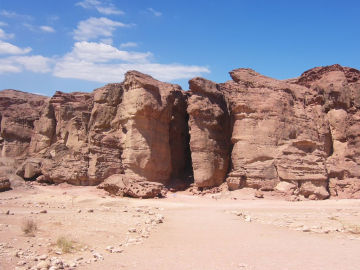
copper during the Egyptian period. Solomon's Pillars are made of
sandstone that juts out in ridges from the tall straight cliffs
along the south-western face of Mt. Timna. The pillars were carved
out through centuries of water erosion. At the foot of Solomon's
Pillars are the remains of a temple to the mining God built by the
Egyptian copper miners. Above the temple is an engraved rock which
bears the praises that Ramses the Third bestowed on the Egyptian
God of Mining. The park includes a lake fed by a pump which brings
it water from an underground aquifer. Near the lake is a parking
area, restaurant, picnic grounds, drinking water and conveniences.
Eilat Heights
Route #12 from Eilat winds its way through the expansive landscapes
between the Edom and the Eilat Mountains. This is the ancient road
to Mecca which was built at the beginning of the 8th century by.
the Egyptian ruler, Mahmud lbn Tulun. The road connected Egypt with
the Eilat Heights and Eilat with Aqaba and Mecca.
Mt. Yoash
At the peak of the Eilat Heights we encounter a junction with a
road going off to the south. This road leads to the summit of Mt.
Yoash overlooking the Eilat Heights' most beautiful panorama. From
this vantage point you can see the borders of four countries - Egypt,
Saudia Arabia, Jordan and Israel. To the south you can see canyons
and cliffs, and to the east, the Gulf and city of Eilat.
Ein Netafim
From the top of the Eilat Heights, a dirt trail winds its way eastwards
and descends to a parking area. A tour route marked in green descends
along a narrow ravine to a pool at its lowest point, the "kalachat".
The pool is at the base of a waterfall descending from the top of
the Netafim River Canyon into a small basin carved out by the British.
The pool developed and filled drop by drop, and herein lies the
origin of its name (translation: Well of Drops). Follow the black
markings for the path leading to the basin.
If you arrive here in the early morning or late afternoon, and you
keep very still, you may see some of the region's wildlife, such
as rock rabbits, gazelles, or flocks of birds such as Tristam's
Grackle and trumpeter finches. Ein Netafim is the only source of
water in the area, making it a popular watering hole. The tour of
Ein Netafim takes about a half hour.
Mt. Hizqiyahu
Milestone 82 marks the peak of Mt. Hizqiyahu. On old maps the peak
is listed as having an altitude of 833 meters. The peak is actually
838 meters high. From this vantage point you can look out over the
Eilat mountains, the Arava desert and the Edom mountains on the
east, and over Moon Valley whose wild landscape looked to the first
settlers of Eilat like the face of the moon, hence its name. To
the west, you can see the ancient route to Mecca, "Darab AI
Haj", that crosses the Sinai desert, descends to the Gulf of
Eilat and continues on to Mecca and Medina.
The Red Canyon
See regional map #2.
From Mt. Hizqiyahu continue northwards, passing through a distinctive
landscape of black and red mountains, with gravel and pebbles covering
the slopes. These are the Neshef Mountains, made of volcanic rock.
After the road crosses the Neshef Mountains, it arrives at a wide
junction with a road leading eastwards (1) (marked in red). This
road leads to the Red Canyon. Follow the road for about 2 km until
you arrive at a parking area (2). From here, carry on along the
trail marked in green, until you arrive at the canyon (3). The canyon
is about 1 50 meters long and 2-3 meters wide. The canyon walls
reach a height of 30 meters. The dominant color in the canyon is
deep red, with sandstone in various shades of red, purple and white.
Flood waters widened the canyon and created niches where one can
stop to rest. At the end of the trail (4), the canyon widens and
colors change. The trail leading back follows the path of the rivulet
to the south and back to the parking area (2). The tour through
the canyon and back takes about two hours.
Birdwatchers Tour
See regional map #3.
The birdwatchers tour, adjacent to the salt ponds, starts from Meeting
Point (1) and follows the north shore. You will see a variety of
sea birds such as gannets, cormorants, western reef heron, and gulls.
Continue northwards along the water canal. On the right you will
see the Oceanography & Lakes Research Institute which, among
other things, is involved in the study of aquaculture. All along
the canal a variety of birds can be seen, including: small waders,
gulls, waterfowl and migrating songbirds such as Bee-eaters, Dead
Sea Sparrows and Spanish Sparrows. When you arrive at Eilat saitflats,
you can visit the ringing station for songbirds (2) (a walk of about
one kilometer), or stroll through the date grove (3) where you will
encounter yellow or grey wagtails, pippits, wheatears and swallows.
There are other varieties of birds in the area, some of which find
shelter among the branches of the date palms. Carry on northwards
along the eastern shore of the canal in the direction of the Jordanian
border crossing. You'll arrive at the entrace to the Bird Sanctuary
where indigenous trees have been specially planted and recycled
refuse provides birds with a welcome food source.
 |
|
 |
|
|